Race PlansUltra

Surf Coast Century Race Plan

Understand the four-leg 100 km course, why the inland half matters, how the 50 km route differs and how to plan food, bottles and resupply on the Surf Coast.

Date
Next edition date TBC · course reference: 2026
Location
Anglesea / Surf Coast, VIC
Distance
50 km · 100 km · 100 km relay
Course
Coastal trail, beach, rock platforms and inland bush tracks

The course

This is an evergreen planning guide based on the organiser's 2026 course description, not confirmation of a 2027 course or date. The event centre is at Anglesea Green and the published distances are 50 km and 100 km, with relay participation also described (course description, competitor services).

The published 100 km course is split into four legs. Leg 1 heads from Anglesea towards Torquay through coastal paths, beach and reef sections; Leg 2 returns through clifftop and bush trails; Leg 3 heads inland through Currawong Falls and Ironbark Gorge to Moggs Creek; Leg 4 returns via coastal viewpoints, Aireys Inlet and beach sections towards Anglesea (2026 course description).

The organiser calls Leg 3 the hilliest leg and crux of the course. For 2026, the 50 km route uses Legs 3 and 4, so it is not simply the opening half of the 100 km (course description).

What the course means for your plan

Our recommendation is to prepare for both exposed coastal running and sustained inland effort. Don't let the event's beach imagery persuade you to plan a flat 100 km.

Budget the later legs from their likely terrain and fatigue. Coastal rock or sand sections can make eating awkward, while a steady walk inland may be a useful opportunity to take familiar food. Rehearse your loaded vest and preserve easy-to-reach fuel for the return leg.

What's on course

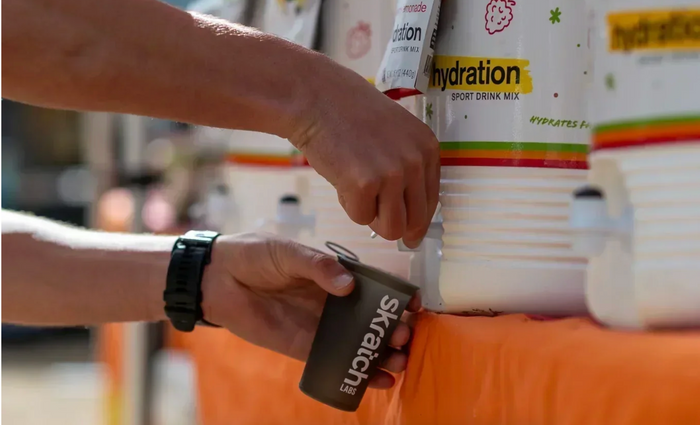
The competitor-services page lists water points and aid stations, with Skratch Hydration Sports Drink Mix powder, sandwiches, fruit, cake, lollies and salty snacks among the supplies. Larger stations list additional foods, with hot options at Moggs Creek. These are published reference details, not guaranteed supplies for the next edition (competitor services).

The 2026 course page names the major leg endpoints as Torquay, Anglesea and Moggs Creek. The services page describes 100 km bag transport to Torquay, Anglesea and Moggs Creek, with details and distances that should be rechecked against the current guide (course, services).

Avoid the 50 km checkpoint trap

The course page says the 2026 50 km uses the latter two legs, while the services page contains 50 km checkpoint-number wording that doesn't clearly align with that description. Don't transplant the 100 km checkpoint numbers or an old 50 km table into a future plan (course, services).

Our recommendation is to make a new sheet from the current distance-specific map: refill point, expected arrival, next-leg time, whether it has food or only water, and permitted support. Carry your own familiar core fuel and ask how on-course drink is mixed before counting its carbohydrate.

Fuelling strategy

Carbohydrate
Individualised · practise first
Fluid
450–750 mL/h starting reference
Sodium
Individual needs, all sources
Caffeine
Optional · track total intake

Surf Coast-specific rehearsal

Our recommendation is to practise bottle handling and food access on a route that mixes coastal and inland terrain. Use the major leg changes as planning milestones, but maintain intake between them. For a relay, carry for your own leg and organise recovery and handover rather than assume access to a solo runner's resupply bag.

Set an intake you can sustain

The Australian Institute of Sport gives 30–60 g carbohydrate/hour for endurance exercise lasting 1–2.5 hours and up to 90 g/hour for events longer than 2.5–3 hours. These are duration-based guidelines, not a requirement for every trail runner.

The 2019 ultra-specific ISSN position stand takes a more conservative approach to very long races, recommending 30–50 g/hour within a broader energy plan and emphasising individual tolerance. Treat the two sources as context, not competing prescriptions: race intensity, time on feet and your rehearsed gut tolerance matter. Higher targets need progressive practice; don't jump to 90 g/hour on race day.

Count everything, not just gels

Add the carbohydrate in gels, drink mix, chews and food. As an illustrative calculation, a practised 60 g/hour plan for a two-hour leg needs 120 g carbohydrate. If a gel's label says 30 g, four gels supply that amount before counting anything in your bottles or food. This is arithmetic, not a product prescription or a universal target.

Split supplies into checkpoint-to-checkpoint portions. Add a modest contingency for slower travel, but separate emergency food from the food you expect to eat. Do not count an uncertain aid-station menu as guaranteed fuel.

Match fluid to conditions

The ISSN position stand suggests 450–750 mL/hour during ultra racing, adjusted for the environment, work rate, body size and tolerance. It is a starting reference, not a volume to force down. Rehearse in similar conditions and combine thirst, your experience and the available refill points when planning.

Carry capacity for the longest expected time between refills, not merely the longest distance. Avoid over-drinking: sodium does not make excessive fluid intake safe, and it does not eliminate exercise-associated hyponatraemia risk (ISSN).

Sodium, caffeine and variety

Individualise sodium using the conditions, your sweat losses and the sodium already supplied by drinks and foods. The ISSN review discusses 500–700 mg sodium per litre of fluid, but that is a drink concentration, not an automatic hourly dose.

Caffeine is optional. The ISSN review advises rehearsing your strategy, counting all doses and avoiding repeated large doses over a long ultra. A caffeinated gel plus coffee plus cola all contribute to the same total; caffeine is not a replacement for safe rest or withdrawal when needed.

Use familiar sweet and savoury options to build a plan you can repeat. Our guides to testing nutrition before a race and avoiding flavour fatigue are useful preparation.

Your plan by distance

Choose your distance. These are preparation frameworks, not predicted finish times or fixed product prescriptions. Use your rehearsed intake and the final race guide to make the plan your own.

50 km soloThe inland and return half in 2026

For a first ultra or runners wanting a substantial coastal-bushland course.

For 2026 the organiser specifies Legs 3 and 4 of the 100 km route (course). Confirm the next edition's route and build your sheet from its own checkpoint distances. Do not assume the shorter event avoids the course's hilliest inland section.

100 km soloFour legs, one sustained nutrition routine

For runners planning a complete day across coastal and inland sections.

The published course has four legs, with Leg 3 described as the crux (course). Carry and resupply by likely leg time. Prepare a familiar savoury alternative and preserve food for the late inland and coastal return sections rather than spend your whole plan on the early runnable kilometres.

100 km relayPrepare your leg and your handover

For team runners whose nutrition requirement depends on their assigned segment.

The organiser describes team changeovers at leg endpoints (course). Calculate your own leg duration, carry its required supplies and confirm where teammates may assist. Keep the team's transport and handover plan separate from a solo runner's drop-bag assumptions.

Race week and race morning

  • Two to three weeks out: complete your final substantial nutrition rehearsal during an appropriate scheduled training session. Use the same vest, bottles, foods and packing system; don't add a long run simply to test nutrition.
  • Race week: read the current runner guide, final course notices, checkpoint departure cut-offs, weather forecast and mandatory equipment list. Confirm transport, gear check and bag-drop deadlines.
  • Before travelling: divide fuel into labelled race legs. Prepare a clear crew sheet with what to hand over, what to refill and what to take away. Pack a spare familiar fuel option.
  • The day before: favour familiar carbohydrate-containing meals, normal hydration and foods you tolerate. Don't attempt to bank hydration by drinking excessive water.
  • Race morning: eat the breakfast and timing you've practised. Check bottles, phone, lights and access to your first leg's fuel. Allow enough time for check-in or transport rather than rushing.
  • At each checkpoint: assess yourself, refill, collect the next leg's supplies and confirm your route. Avoid letting an unplanned long stop consume your cut-off margin.
  • If you feel unwell: tell race medical staff. Confusion, collapse or persistent vomiting are not problems to push through by taking more gels or salt.
  • After finishing: change into dry clothing, eat and drink according to tolerance and arrange safe transport. Don't drive if exhausted or sleep-deprived.

Frequently asked questions

Is the 50 km the first half of the 100 km?

Not in the 2026 description: it uses Legs 3 and 4 (official course page). Recheck the next edition's map rather than infer its route from the race name.

Is there a confirmed next-edition date in this guide?

No. This guide deliberately uses the 2026 course description as a reference and does not infer a 2027 date. Use the organiser's current event announcement before arranging travel.

Can I count the on-course sports drink as my whole fuel plan?

Our recommendation is to count only a concentration and quantity you can verify and have practised. The services page lists Skratch powder but does not establish the exact carbohydrate in every cup or bottle for a future edition. Carry a familiar fallback.

Is the route entirely beach running?

No. The official course description includes coastal paths, beach and reef terrain plus inland bush tracks, Currawong Falls and Ironbark Gorge. Our recommendation is to train and fuel for that mix rather than a uniformly flat shoreline.

Event reference: official information.

Event reference: official information.

Nutrition context: AIS carbohydrate guidance and the 2019 ISSN ultra-marathon position stand. This is general educational guidance, not personalised medical or dietetic advice. Confirm current race rules and consult an accredited sports dietitian for individual requirements.

Last reviewed 2 October 2026

Keep reading

More race plans